The 2026 Breakthrough in Crohn’s Treatment: Why Selective IL-23 Inhibitors are Changing the Game
Breakthrough in Crohn’s Treatment
If you or someone you love is managing moderately to severely active Crohn’s disease, you already know how exhausting the journey can be. Finding a treatment that brings true, long-term relief often feels like a frustrating game of trial and error.
For a long time, anti-TNF therapies (like Remicade and Humira) have been the standard go-to options. But the tough reality is that many people either don’t respond to them, or find that they stop working after a while.
Fortunately, the world of gastroenterology is experiencing an incredibly exciting shift. A new class of highly precise treatments—called Selective IL-23 (p19) Inhibitors—is completely redefining what remission looks like. They are offering unprecedented healing for the gut lining and a massive upgrade in convenience for patients.
Let’s dive into the science and look at why selective IL-23 targeting is the most significant clinical breakthrough for Crohn’s disease today.
1. The Science of Precision: Why “Selective” Targeting is a Big Deal
To understand why this breakthrough is making waves, it helps to look at how our immune system triggers gut inflammation.
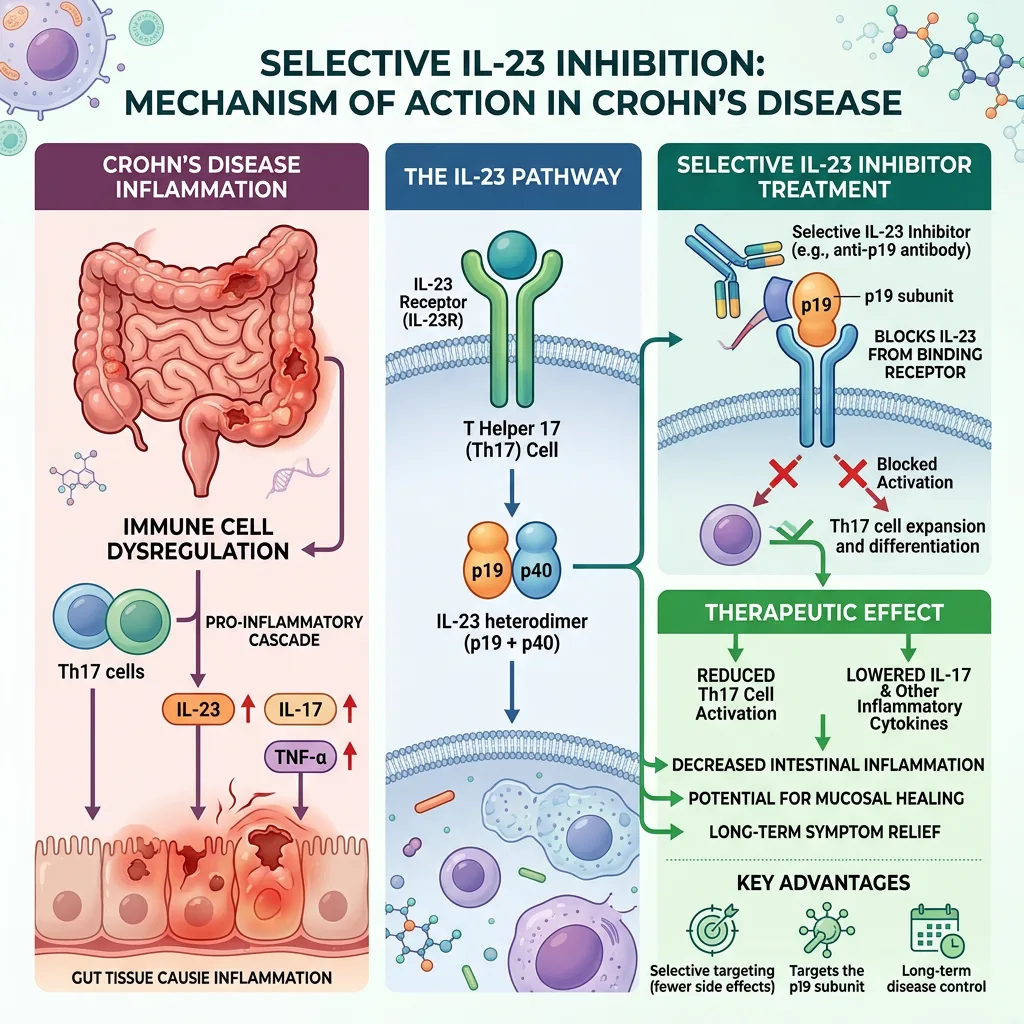
Older biologics, like Ustekinumab (Stelara), work by targeting a protein subunit called p40. This subunit is shared by two different inflammatory messengers in the body: Interleukin-12 (IL-12) and Interleukin-23 (IL-23).
However, modern research has shown us something incredibly important:
- IL-23 is the real troublemaker here—it’s a primary driver of the chronic, destructive inflammation in the gut for Crohn’s patients.
- IL-12 actually does a lot of good! It helps your body defend itself against certain infections and other illnesses.
By shifting to a selective IL-23 inhibitor, newer medications zero in exclusively on the p19 subunit of IL-23. This leaves your helpful IL-12 completely free to keep protecting you. Think of it as a highly focused, precise strike: it shuts down the specific inflammation in your gut while sparing other vital parts of your immune defense.
2. Meet the Modern Options: Risankizumab and Guselkumab
Today, there are two major selective IL-23 inhibitors transforming the landscape of Crohn’s care:
Risankizumab (Skyrizi)
Approved for Crohn’s in 2022, Risankizumab was the pioneer of this class. It is given through an initial intravenous (IV) phase at a clinic, followed by at-home maintenance injections every 8 weeks. It quickly set a new standard for helping patients feel better and actively healing the bowel lining.
Guselkumab (Tremfya)
The latest big news in the IBD community is the FDA approval of Guselkumab for Crohn’s disease, backed by highly anticipated Phase 3 clinical trial data:
- The GALAXI-2 and GALAXI-3 Trials: These large studies evaluated adults with moderately to severely active Crohn’s. The results showed that Guselkumab achieved incredible rates of deep mucosal healing and clinical remission—even in patients who had already tried and failed other biologics.
- The GRAVITI Study: This trial was an absolute game-changer for patient freedom. It proved that a subcutaneous-only induction and maintenance protocol—meaning simple injections under the skin from day one, rather than starting with an IV infusion in a clinic—is both highly effective and safe.
3. What This Means for Your Everyday Life
All of this clinical data translates into three very real, practical benefits for patients:
- Deep Healing (Not Just Feeling Better): In the past, “remission” just meant your symptoms went away. Today, doctors aim for true mucosal healing—literally repairing the physical tissue of the gut lining. Selective IL-23 inhibitors have shown some of the highest rates of tissue healing ever recorded, which drastically cuts down the risk of long-term complications and future surgeries.
- Goodbye, Infusion Centers! Traditional biologics often require you to sit in an outpatient clinic for hours to get your starter doses. Thanks to the new GRAVITI protocol, Guselkumab offers a 100% at-home option. You can take your very first doses at home using a pre-filled pen or syringe, giving you total independence from the clinic.
- A Second Chance: If your body hasn’t responded well to classic therapies like Remicade or Humira, don’t lose heart. The latest trials prove that selective IL-23 inhibitors are incredibly effective for patients who have already been through the ringer with other treatments.
Quick Comparison: Risankizumab vs. Guselkumab
| Feature | Risankizumab (Skyrizi) | Guselkumab (Tremfya) |
| How it Works | Targets IL-23 (p19 subunit) | Targets IL-23 (p19 subunit) |
| Starting Out (Induction) | Intravenous (IV) at Weeks 0, 4, and 8 | Choice of Subcutaneous (SC) injections OR IV |
| Staying Well (Maintenance) | At-home injection every 8 weeks | At-home injection every 4 or 8 weeks |
| The Biggest Perk | Backed by years of trusted, real-world success and excellent tissue healing. | The GRAVITI Protocol allows for 100% at-home therapy from Day 1—no clinic visits required. |
The Takeaway
The era of precision medicine for Crohn’s disease is officially here. Selective IL-23 inhibitors like Risankizumab and Guselkumab represent a safer, more focused, and much more convenient way to manage inflammation.
If your current treatment plan is falling short, or if you are tired of the logistical headache of traveling to infusion clinics, it’s a great time to advocate for your health. Schedule a friendly chat with your gastroenterologist and ask if a selective IL-23 inhibitor—and specifically an at-home injection routine—might be the right key to helping you heal and get your quality of life back.
💡 A Quick Note: This post is for educational and informational purposes only and does not take the place of professional medical advice. Always talk with your doctor or healthcare team before making changes to your treatment plan.
</div><span></span><div>Get Healthy Crohns on Google Play
Track food, sleep, meds and symptoms privately on your phone.
An iPhone version is currently in production.
Or get new articles and app updates by email:
I am not a doctor. This is not medical advice. Check with your care team before changing treatment, diet or supplements.